
Stakeholders Can Make or Break Your Project

One of the biggest mistakes I see organizations make is assuming they already know who their stakeholders are.
Too often, new project managers or teams only think about the obvious stakeholders like the funder, the client, or the people who will ultimately benefit from it. While these groups are certainly important, they rarely represent everyone who can influence the success of an initiative, especially when it comes to large scale projects.

Many projects exist within a wider ecosystem of people, organizations, regulators, partners, and communities. Some will champion your project, others may have concerns, and some may have the power to delay or even stop your initiative altogether.
That's why stakeholder management is one of the most important activities you'll undertake during project planning.
Why Does It Matter?
Every project depends on people. Ignoring stakeholders doesn't make them disappear. It simply means you're less prepared when their influence begins to shape your project.
I've found that projects can even be delayed not because the technical solution was wrong, but because the right people weren't identified or engaged early enough.
Look Beyond the Obvious
One of the most common mistakes organizations make is thinking too narrowly about who their stakeholders are.
Imagine your organization is developing a new water treatment facility to improve access to clean water. Your first thought might be to identify the funding agency and the people who will receive the water. Both are stakeholders but they're only part of the picture.
You may also need to consider:
Government ministries, departments and agencies
International development banks or grant providers
Environmental agencies
Utility companies
Engineers and contractors
Local communities living near the construction site
Community leaders
Advocacy groups
Regulatory authorities
Maintenance teams
The media
Partner organizations
Each of these groups has different priorities, requires different information, different concerns, and different levels of influence over the project's success. Some will require regular updates. Others may only need occasional communication. Some will need to approve key decisions before the project can move forward. Understanding these differences is what effective stakeholder management is all about.
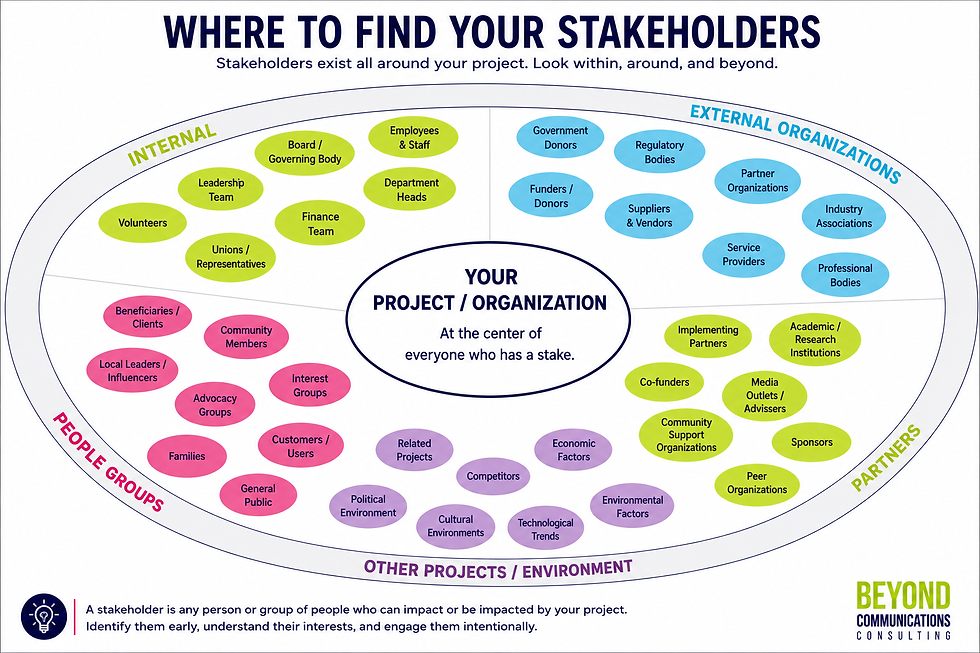
So how does one find their stakeholders?
Step 1: Identify Your Stakeholders
The first step is simply identifying everyone who has a stake in your project using a preliminary stakeholder register. Find a template here:
As you brainstorm, ask yourself questions such as:
Who is funding this project?
Who will benefit from it?
Who could influence its success?
Who could delay or stop the project?
Who will approve major decisions?
Who will maintain the project after implementation?
Who and what will be affected, even indirectly?
At this stage, don't worry about whether someone is "important enough." Capture everyone you can come up with whether they are internal to your organisation or external.
If you're not sure who all your stakeholders are, talk to your team members, look at documentation from other similar projects and maybe reach out to some of the stakeholders you know to get their perspective on who else needs to be considered.
Step 2: Assess Their Influence and Interest
Not every stakeholder requires the same level of attention. Once you've identified your stakeholders, ask yourself:
How much influence do they have over the project?
How interested are they in its outcome?
This helps you determine where to focus your time and resources.
Tip: Note down why you think they are at that level as well. This can help when adjusting it later as more information comes to light.
For example, a major funding organization may have both high influence and high interest, requiring regular meetings, formal reporting, and ongoing engagement.
On the other hand, members of the public may have lower influence individually but still require clear communication to maintain trust and support. They may even require a dedicated person or team for ongoing engagement with them depending on project requirements.
Step 3: Create a Stakeholder Mapping Matrix
One of the simplest tools for visualizing stakeholders is a Stakeholder Mapping Matrix. The version I most commonly use maps stakeholders according to two factors:
Level of Influence
Level of Interest

This matrix helps determine how closely different stakeholders should be managed throughout the project. Rather than treating everyone the same, it allows you to tailor your engagement based on their role and potential impact.
Step 4: Build a Stakeholder Register
While the stakeholder matrix helps you prioritize stakeholders, the stakeholder register is where the real planning happens.
A stakeholder registers can include information such as:
Stakeholder name
Organization
Role in the project
Level of influence
Level of interest
Communication preferences
Contact information
Current and intended level of engagement
Engagement strategy
Frequency of communication
Key concerns or expectations

Think of the stakeholder register as your project's relationship management tool. It helps you to give every important stakeholder the right information at the right time through the most appropriate communication channels.
Get a free stakeholder mapping matrix and register template here.
Your Stakeholders Aren't Static
Projects evolve, and so do stakeholders. A new funder may come on board. A project sponsor may change roles. Community concerns may emerge. Government priorities may shift. For these and many more reasons, stakeholder management shouldn't be completed once and forgotten.
Your stakeholder map and stakeholder register should be reviewed and updated throughout the project to reflect changing circumstances, new relationships and new strategies that should be implemented.
Final Thoughts
The organizations that consistently deliver successful projects understand that stakeholder management is about building trust, managing expectations, and getting the right people involved at the right time.
Stakeholder management is one of the 10 core elements of any project proposal or project management plan that I prepare for clients, as it lays the foundation for everything that follows.
If you're planning a new project and need support turning your idea into a well-structured, actionable plan, I'd love to help. Whether you're just getting started or preparing a proposal for funding or approval, book a consultation to discuss who how we can bring it to life.

Comments